> For the complete documentation index, see [llms.txt](https://docs.gmetri.com/llms.txt). Markdown versions of documentation pages are available by appending `.md` to page URLs; this page is available as [Markdown](https://docs.gmetri.com/metaverse/build/editor/viewport_properties.md).
# Viewport Properties
Viewport Properties is an [editor](/metaverse/build/editor.md) panel that facilitates the movement and placement of items within your experience.
Viewport properties
## Camera Mode
### First Person Camera Mode
First person camera mode
First person mode allows you move along the plane at a given height using the WASD or the arrow keys. You can control this height from the Top Bar.
### Fly Camera Mode
Fly Camera Mode
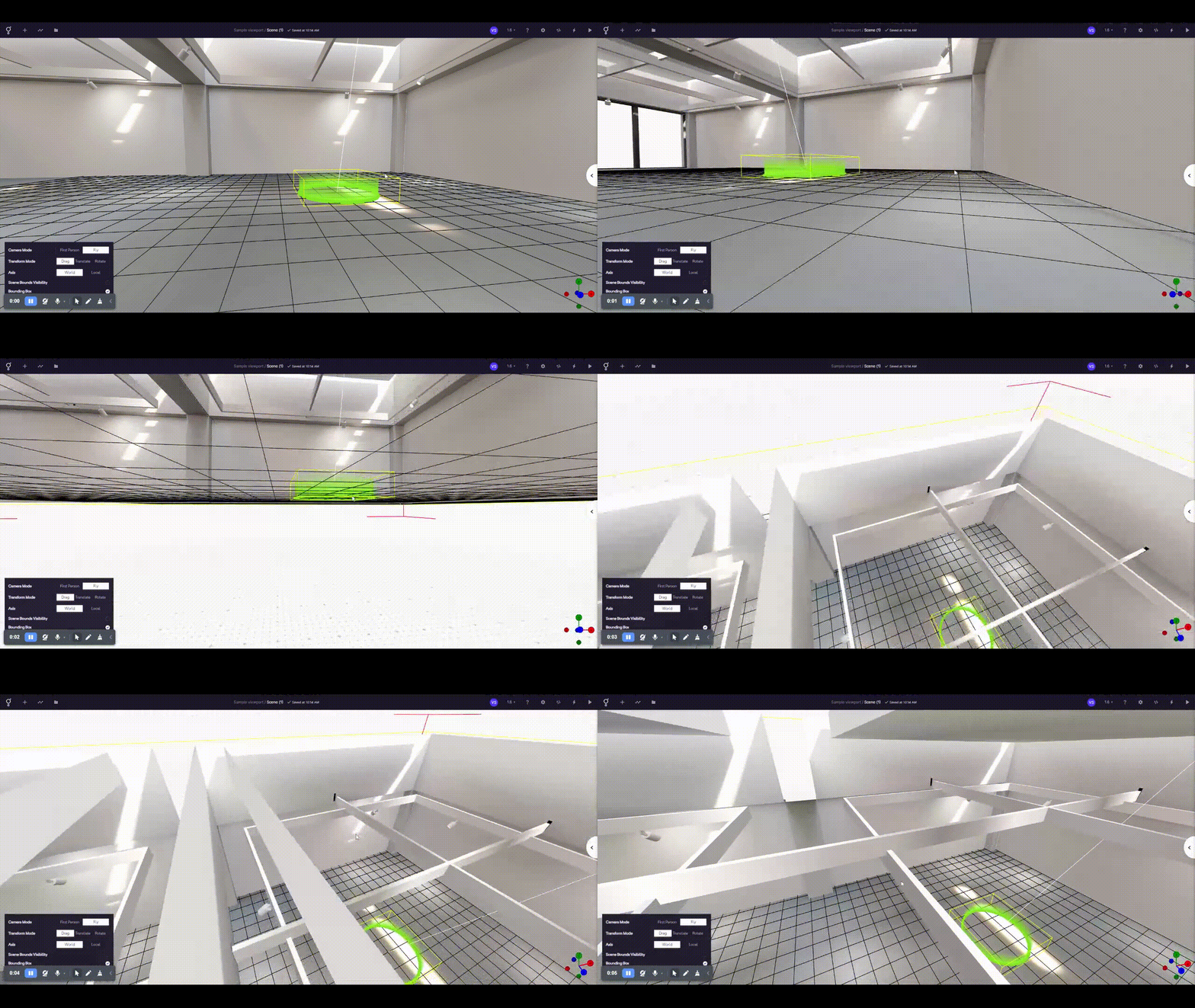
In Fly Mode, you can:
* Use left click and drag to orbit around a point
* Use scroll bar to move forward and backward
* Use right click and drag to pan
## Transform Mode
The transform how you move elements in the editor.
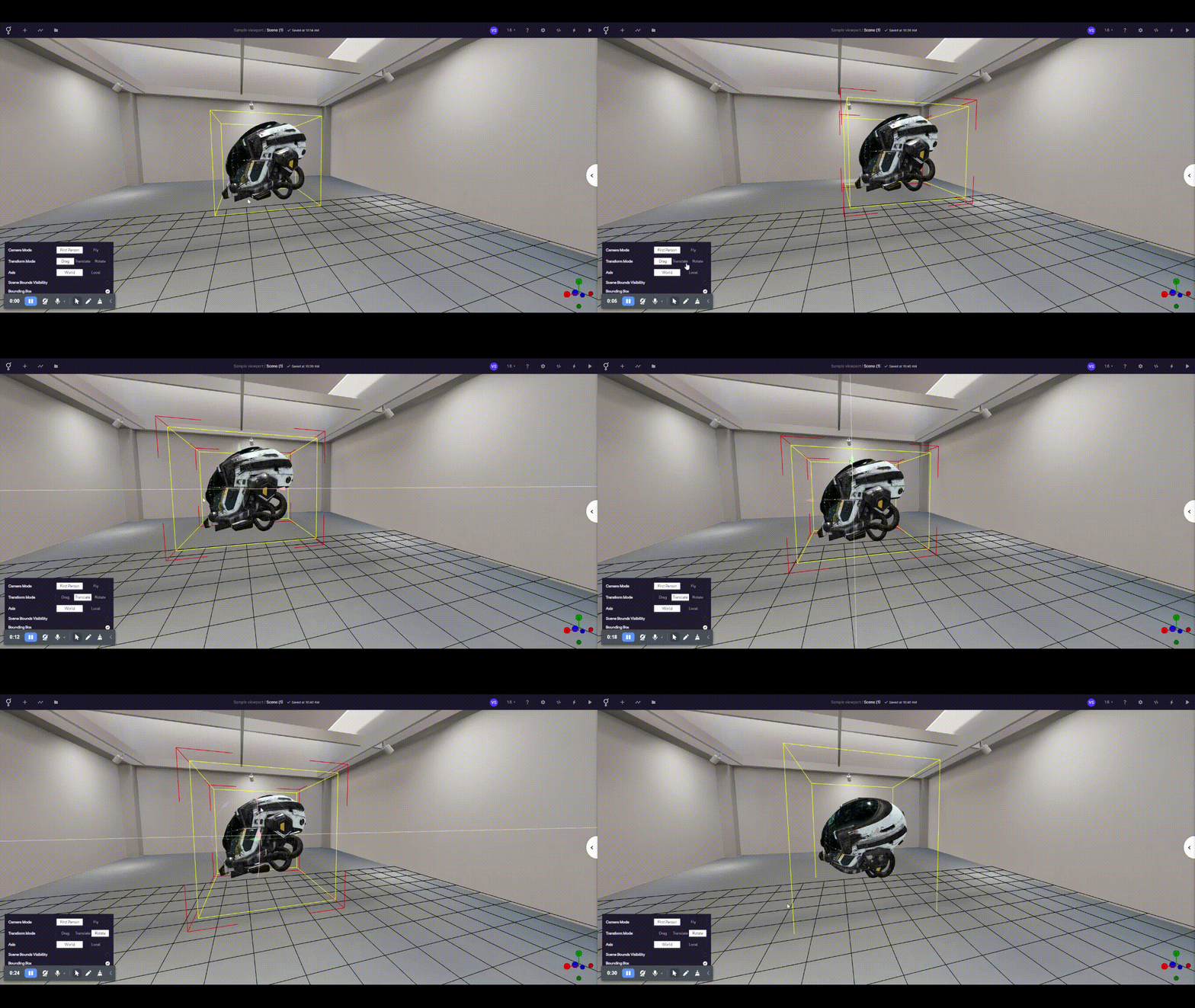
There are 3 transform modes:
* Drag: Moves the element across a spherical plane with the camera as the center
* Translate: Shows the Transform arrows that allows you to move the element across `x`, `y` or `z` axes or `xy`, `yz` or `zx` planes.
* Rotate: Shows the Rotation controls that allow you to rotate the element across `x`, `y` or `z` axes.
{% hint style="info" %}
The axes in question above can be relative either to the World or the local element. Control this by using the Axis setting below.
{% endhint %}
You can refer to the below article to understand how this mode works in a 3D space.
{% content-ref url="/pages/AfIppqoDeneuruZzMj1Z" %}
[Placement in 3D Space](/metaverse/build/editor/placement-in-3d-space.md)
{% endcontent-ref %}
Transform Mode
## Axis
The translate and rotate controls can be relative to one of two available axes - World or Local.
Axis
## Scene Bound Visibility
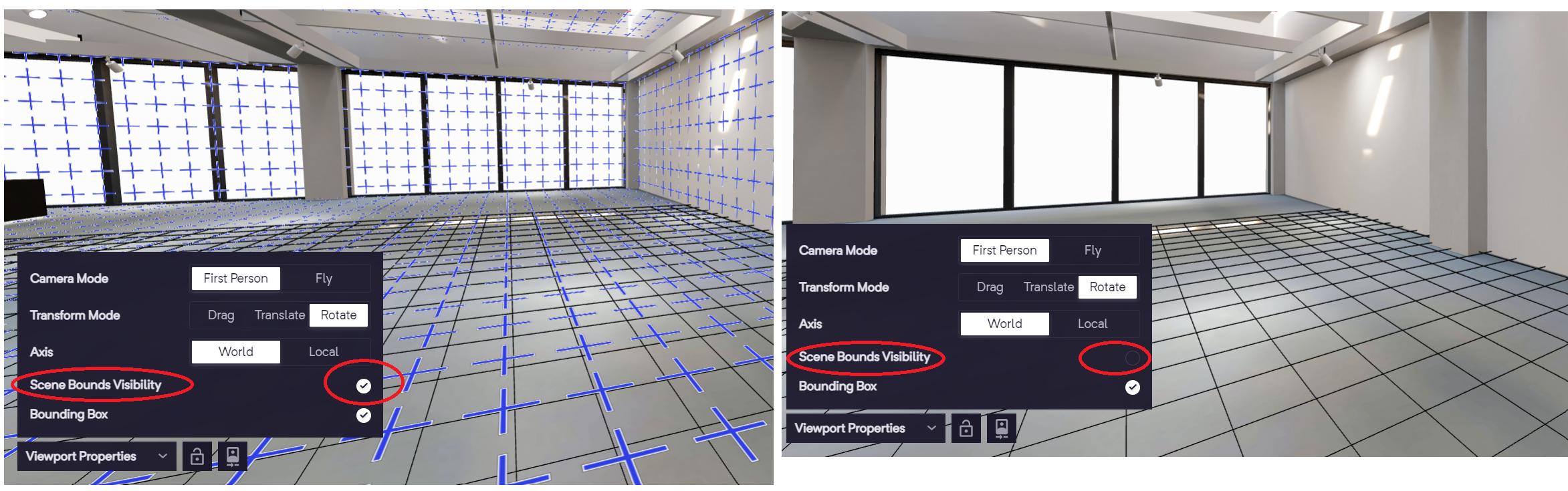
You can change the visibility of the scene boundary using this setting.
You can refer to scene bounds in the below article to understand how they work
{% content-ref url="/pages/3WcLIPQc5o8vlCYL8hUf" %}
[Colliders](/metaverse/build/scenes/3d-scene/colliders.md)
{% endcontent-ref %}
Scene Bound visibility
## Bounding Box
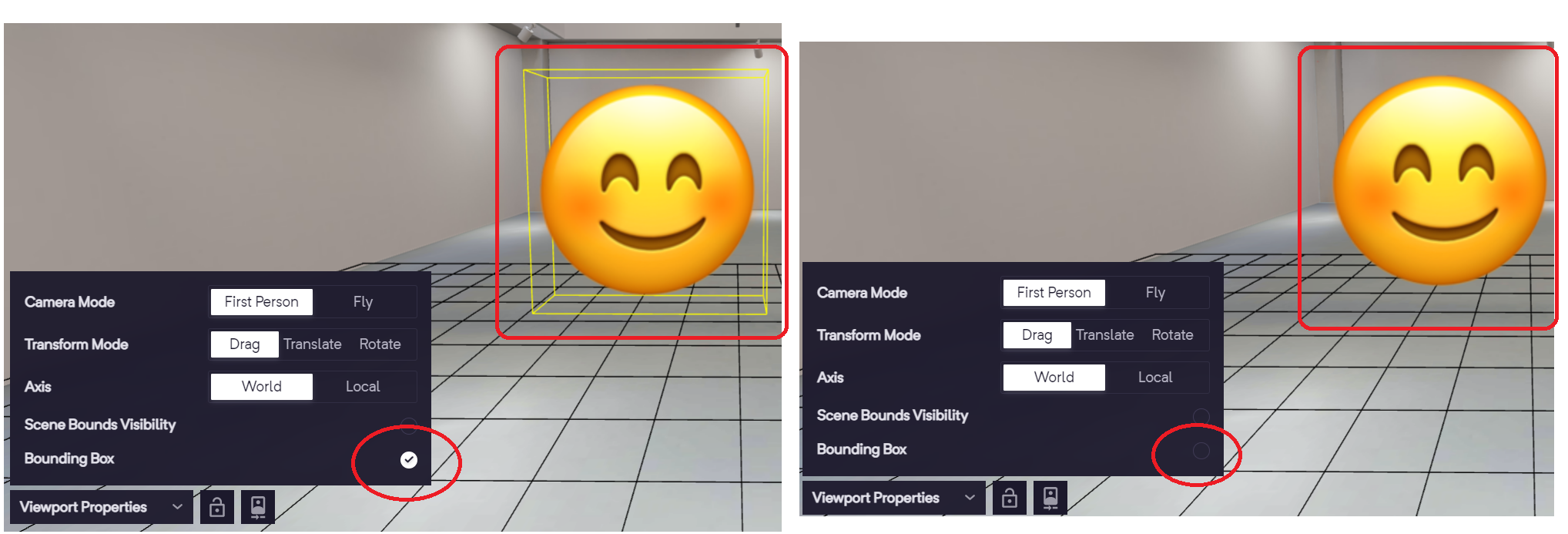
This is 3D cuboid frame that encloses an element within the experience. It is used to represent the dimensions and position of an item.
Shown below are examples with and without bounding box visibility.
Bounding box
---
# Agent Instructions
This documentation is published with GitBook. GitBook is the documentation platform designed so that both humans and AI agents can read, navigate, and reason over technical content effectively. Learn more at gitbook.com.
## Querying This Documentation
If you need additional information that is not directly available in this page, you can query the documentation by asking a question.
Perform an HTTP GET request on the following URL with the `ask` and `goal` query parameters:
```
GET https://docs.gmetri.com/metaverse/build/editor/viewport_properties.md?ask=&goal=
```
`ask` is the immediate question: it should be specific, self-contained, and written in natural language.
`goal` is what the user is ultimately trying to achieve, the reason they need the answer. Sharing it helps GitBook give you a better, more relevant answer. A goal is most helpful when it describes the outcome the user wants rather than restating the question. For example, with `ask=how do I create an API token`, a goal like `automate deployments from our CI pipeline` lets GitBook tailor the answer to that use case.
The response will contain a direct answer to the question and relevant excerpts and sources from the documentation.
Use this mechanism when the answer is not explicitly present in the current page, you need clarification or additional context, or you want to retrieve related documentation sections.