> For the complete documentation index, see [llms.txt](https://docs.gmetri.com/llms.txt). Markdown versions of documentation pages are available by appending `.md` to page URLs; this page is available as [Markdown](https://docs.gmetri.com/metaverse/build/scenes/3d-scene/colliders.md).
# Colliders
Colliders are structures that prevent viewers from walking through a space.
There are three types of colliders - Scene Bounds, Collider Volume, Collider Mesh
{% hint style="info" %}
For colliders to work, ensure that "**Enable Collisions**" is enabled in Scene Properties
{% endhint %}
## Scene Bounds
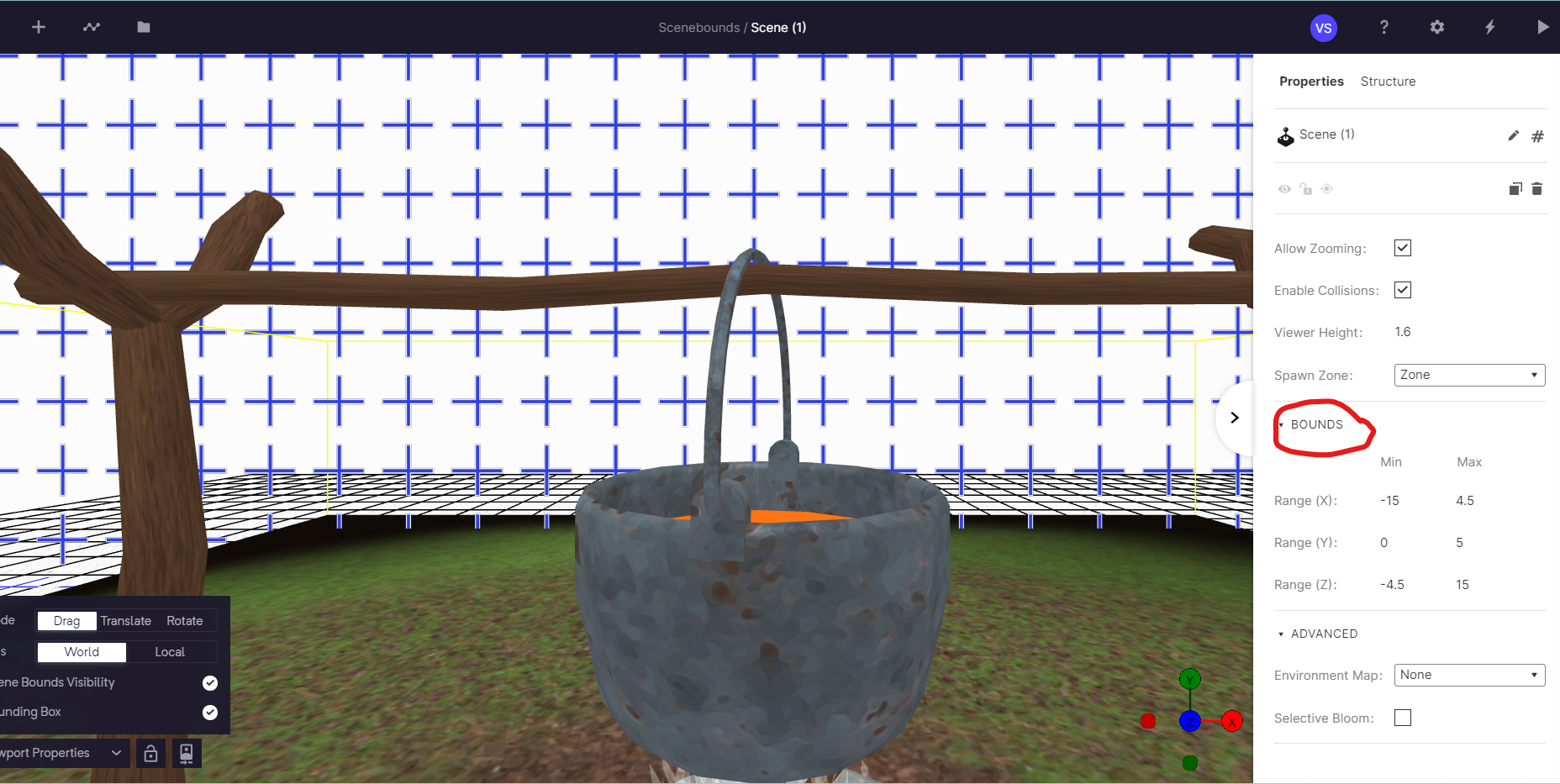
Scene Bound is the boundary of your scene. Every place that you want the viewer to visit should be within the Scene Bounds.
In the editor, scene bounds are visible as a grid and can be toggled from the **Viewport Properties**. Scene bounds are only visible in the editor - you can't see them in the deployed link.
Scene Bounds
### How can I change Scene Bounds?
To modify the Scene bounds of your scene, go to the 'Structure' option and select 'Scene'. Then, you can adjust the X, Y, and Z axis ranges to make the necessary changes.
How to change the scene bounds in your experience
{% hint style="info" %}
If you want to remove Scene Bounds - set its size to 0
{% endhint %}
Here's an example experience for Scene Bound. The scene bounds prevent you from going near the windows.
{% embed url="" %}
Scene bounds - Sample experience
{% endembed %}
## Collider Volume
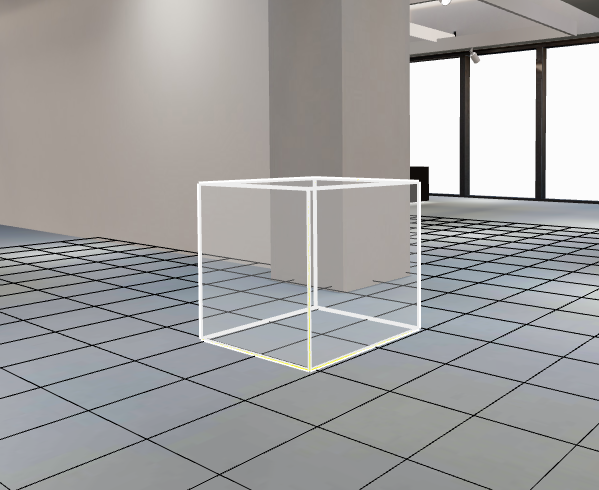
A Collider Volume is an invisible box/sphere/cone/volume that objects will rest on top of. Without colliders, viewers will fall through floors and go through walls and benches. The position, shape and dimensions of this volume can be adjusted from the properties panel.
Collider box element
In view, the collider box elements are represented as invisible cubes with which the players will collide and not walk through.
## Collider Mesh
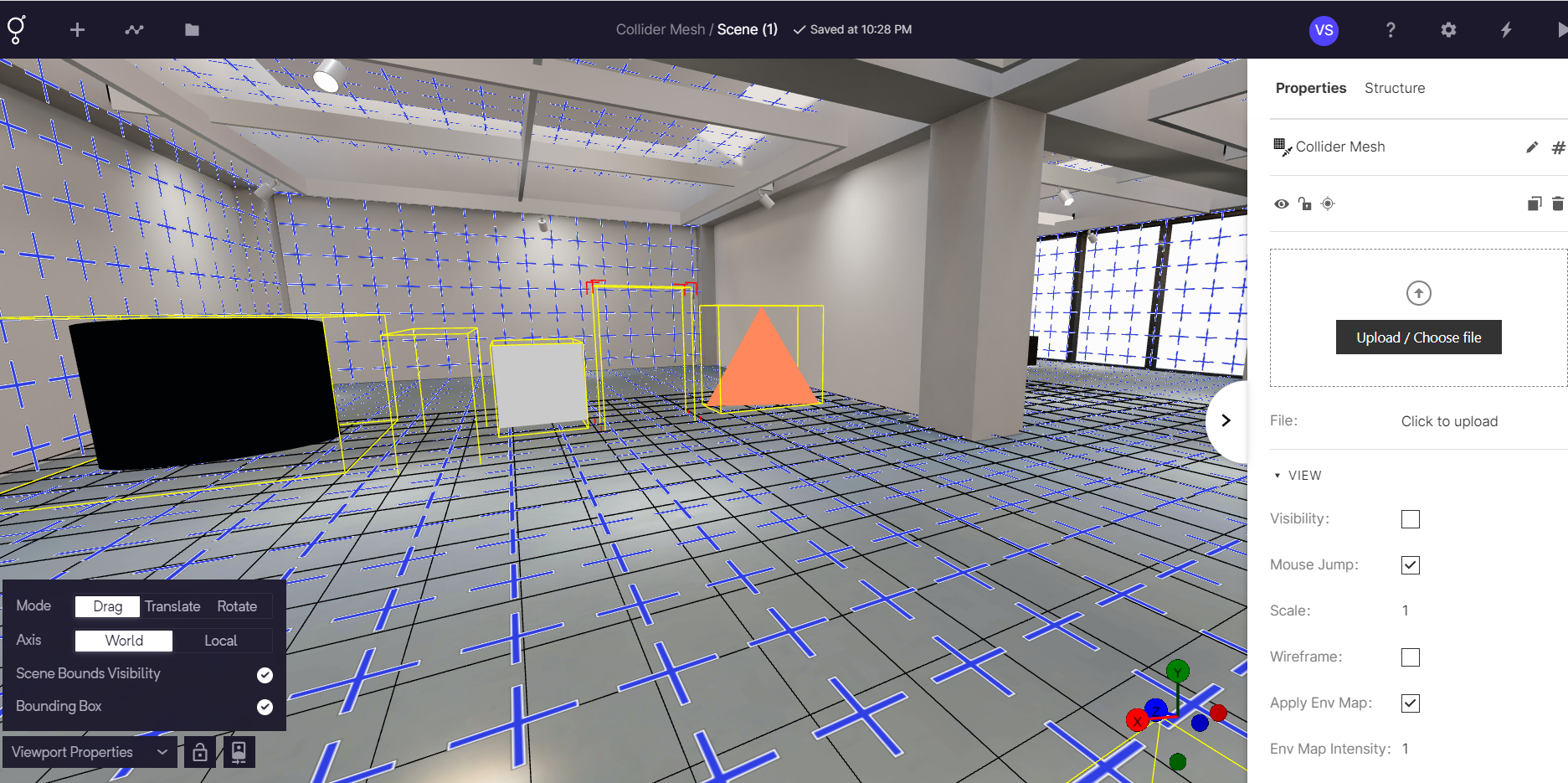
Enhance your experience by incorporating a 3D object that has collision capabilities. You can either upload your own customized 3D model or choose one from our pre-installed libraries.
Collider Mesh
## Collider Example
Here's an example of how a collider works on an experience:
{% embed url="" %}
Colliders - Sample experience
{% endembed %}
## Video Tutorial for Colliders
{% embed url="" %}
Collider Tutorial
{% endembed %}
---
# Agent Instructions
This documentation is published with GitBook. GitBook is the documentation platform designed so that both humans and AI agents can read, navigate, and reason over technical content effectively. Learn more at gitbook.com.
## Querying This Documentation
If you need additional information that is not directly available in this page, you can query the documentation by asking a question.
Perform an HTTP GET request on the following URL with the `ask` and `goal` query parameters:
```
GET https://docs.gmetri.com/metaverse/build/scenes/3d-scene/colliders.md?ask=&goal=
```
`ask` is the immediate question: it should be specific, self-contained, and written in natural language.
`goal` is what the user is ultimately trying to achieve, the reason they need the answer. Sharing it helps GitBook give you a better, more relevant answer. A goal is most helpful when it describes the outcome the user wants rather than restating the question. For example, with `ask=how do I create an API token`, a goal like `automate deployments from our CI pipeline` lets GitBook tailor the answer to that use case.
The response will contain a direct answer to the question and relevant excerpts and sources from the documentation.
Use this mechanism when the answer is not explicitly present in the current page, you need clarification or additional context, or you want to retrieve related documentation sections.