> For the complete documentation index, see [llms.txt](https://docs.gmetri.com/llms.txt). Markdown versions of documentation pages are available by appending `.md` to page URLs; this page is available as [Markdown](https://docs.gmetri.com/metaverse/publishing/authentication/sso.md).
# SSO
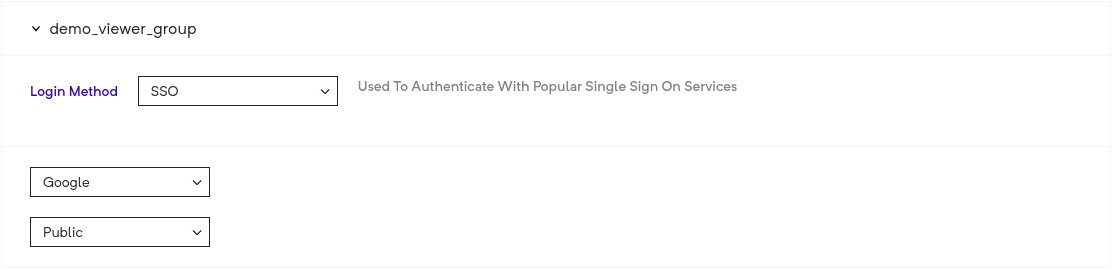
This option allows you select either `Google`, `Microsoft (Azure)` or `SAML` based login for viewers.
## Google and Microsoft Azure based SSO
When you use this, you have three options:
* Public - all people with valid (google or azure based on your selection) accounts are allowed to access your deployment.)
* Filter By domain - all people with valid google or azure based accounts on the domain that you have set are allowed to access your deployment.
* Filter By viewer list - all accounts google or azure based accounts in your viewer list are allowed to access your deployment.
## SAML based SSO
This is a viewer group authentication mechanisms support for the [Security Assertion Markup Language](https://docs.oasis-open.org/security/saml/Post2.0/sstc-saml-tech-overview-2.0.html).
#### Identity Provider Setup
Any SAML identity provider (IdP) can be configured to be used for authentication of a viewer.
To enable this, head over to the `Viewer Group` page, then:
1. Select SSO as your `Login Method`.
2. Now select `SAML` from the `Provider` drop-down menu.
3. After this, you will be asked to provide your SAML IdP configuration.
You should see the config as follows:
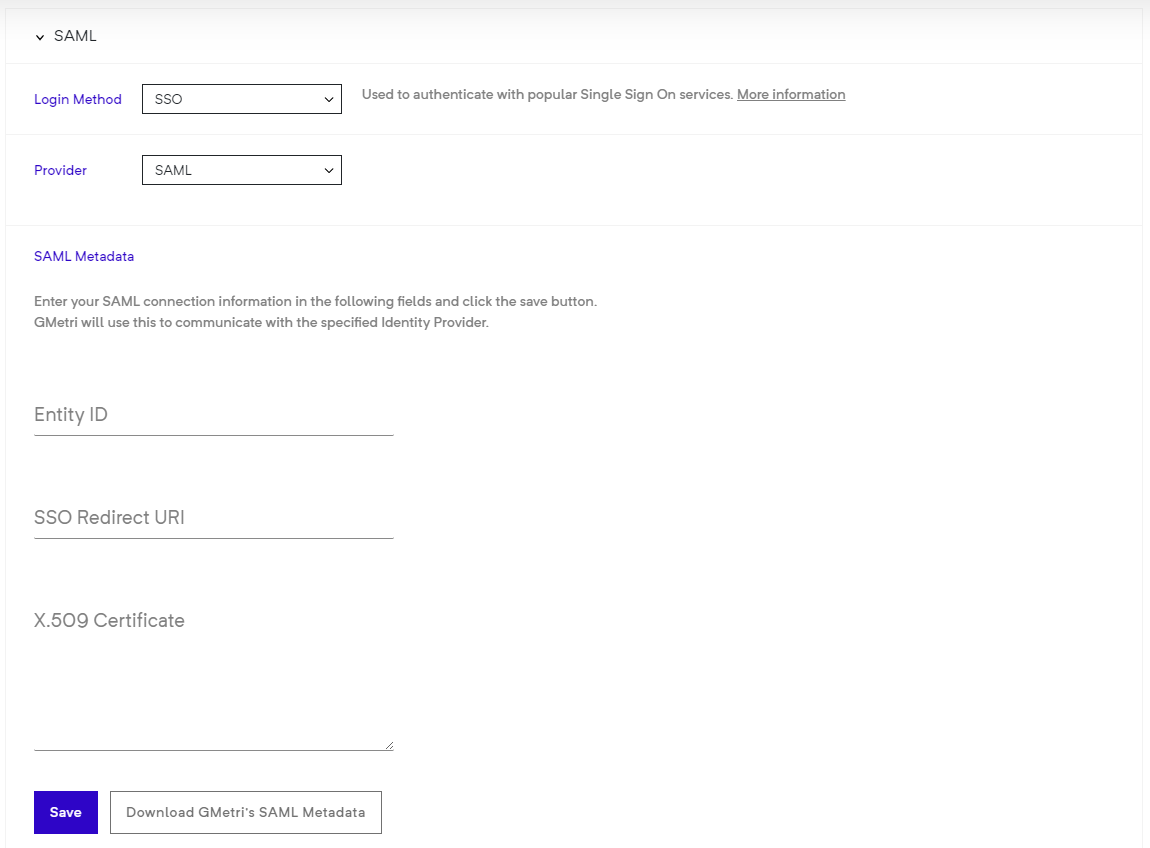
1. Enter your IdP's `entityId`, `SSO redicrection URL` and `X.509 signing certificate`.
2. Click the `Save` button to finally save your configuration.
3. To register GMetri as a service provider (SP) with your IdP, you will need the configuration details. You can get these details by clicking the `Download GMetri's SAML Metadata` button.
You can find sample metadata configuration [here](https://samltest.id/download/) under the `SAMLtest's IdP` section. This will give you an idea of what you need to paste in the boxes for the SAML config.
**NOTE on pasting X.509 certificate**
{% hint style="warning" %}
Please paste certificate *without* the `----BEGIN CERTIFICATE----` and `----END CERTIFICATE----` part.
{% endhint %}
### Deployment Setup
Once you create a SAML viewer group, head to your deployment and set this viewer group as the authentication mechanism for that deployment.
### Viewer
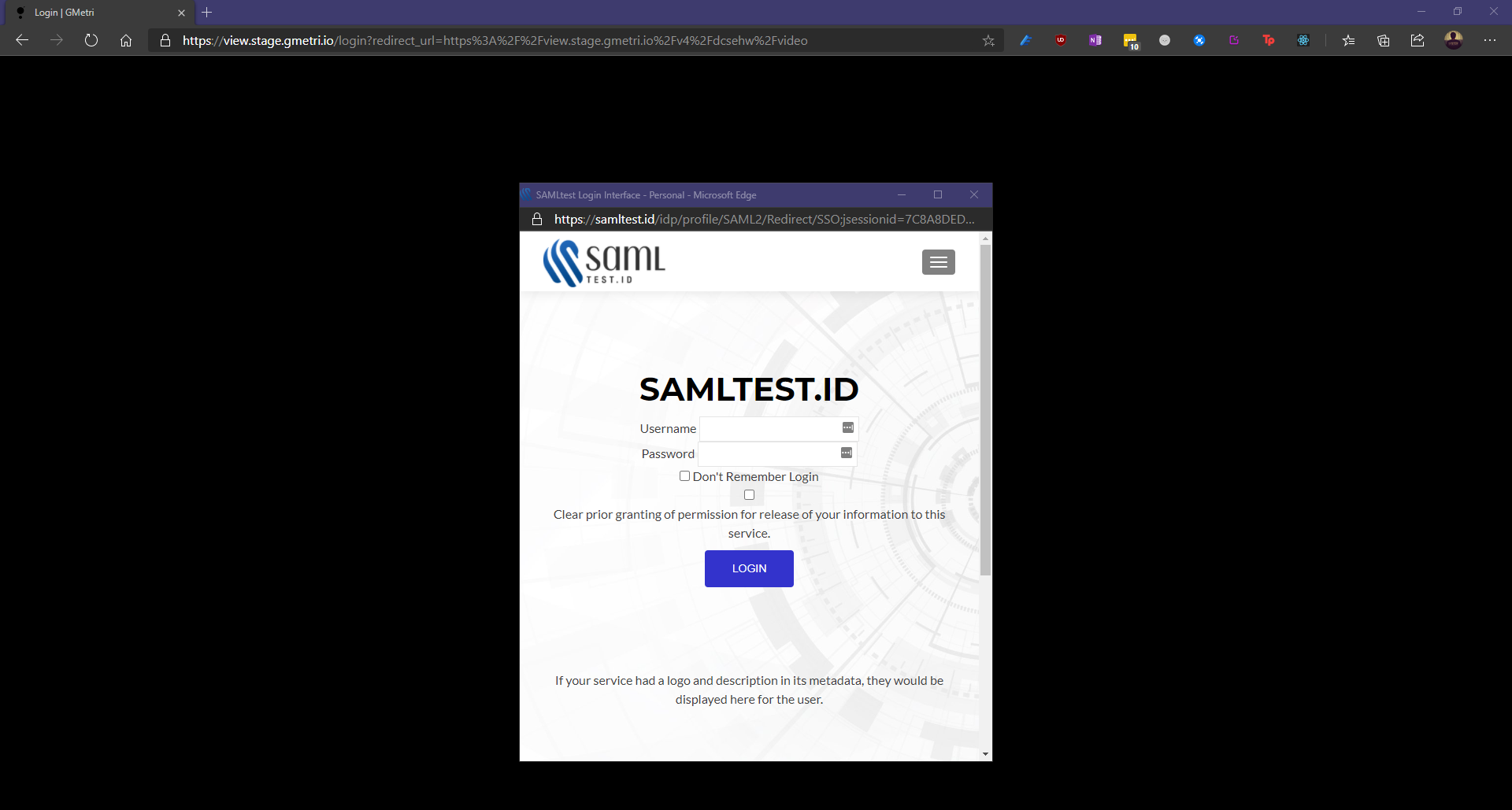
* Once you open a viewer link for deployment with a SAML SSO based viewer group, you will see a pop-up with the IdP's login page.
* Post-IdP login process, you will be redirected back to `view.gmetri.com`.
* We use your `email address` sent to us by the `IdP` as the primary identifier for the viewer session.
#### SAML configuration
* Name Identifier format: `urn:oasis:names:tc:SAML:1.1:nameid-format:unspecified`
* In IdP `SAMLResponse` we look for the following attributes:
| Friendly name | Name | NAMEFORMAT |
| ------------- | --------------------------------------------------- | ------------------------------------------------- |
| Email | `email`/`mail` | `urn:oasis:names:tc:SAML:2.0:attrname-format:uri` |
| Display Name | `displayname` / `urn:oid:2.16.840.1.113730.3.1.241` | `urn:oasis:names:tc:SAML:2.0:attrname-format:uri` |
{% hint style="info" %}
SAML authentication will not be successful unless the `IdP` returns your `email` in its SAML response.
{% endhint %}
---
# Agent Instructions
This documentation is published with GitBook. GitBook is the documentation platform designed so that both humans and AI agents can read, navigate, and reason over technical content effectively. Learn more at gitbook.com.
## Querying This Documentation
If you need additional information that is not directly available in this page, you can query the documentation by asking a question.
Perform an HTTP GET request on the following URL with the `ask` and `goal` query parameters:
```
GET https://docs.gmetri.com/metaverse/publishing/authentication/sso.md?ask=&goal=
```
`ask` is the immediate question: it should be specific, self-contained, and written in natural language.
`goal` is what the user is ultimately trying to achieve, the reason they need the answer. Sharing it helps GitBook give you a better, more relevant answer. A goal is most helpful when it describes the outcome the user wants rather than restating the question. For example, with `ask=how do I create an API token`, a goal like `automate deployments from our CI pipeline` lets GitBook tailor the answer to that use case.
The response will contain a direct answer to the question and relevant excerpts and sources from the documentation.
Use this mechanism when the answer is not explicitly present in the current page, you need clarification or additional context, or you want to retrieve related documentation sections.