> For the complete documentation index, see [llms.txt](https://docs.gmetri.com/llms.txt). Markdown versions of documentation pages are available by appending `.md` to page URLs; this page is available as [Markdown](https://docs.gmetri.com/metaverse/build/variables.md).
# Variables
If you want to save any data, and/or modify it later, you can use **Variables.**
**Variables** are used to store information to be referenced and manipulated. It is helpful to think of variables as containers that hold information.
GMetri experiences fully embrace "variables". Variables allow you to gamify your experiences and orchestrate a variety of interactions. If you want to add interactivity, you would almost always use variables (along with [Rules](/metaverse/build/rules.md)).
{% hint style="info" %}
Using variables is a very powerful tool that can be used to gamify any experience.
{% endhint %}
## Types Of Values in Variables
Variables can store three kinds of values:
* [**Numbers**](/metaverse/build/rules/number-variable-rules.md)
* [**String**](/metaverse/build/rules/string-variable-rules.md) (Any character, word, sentence)
* [**Booleans**](/metaverse/build/rules/boolean-variable-rules.md) (TRUE/FALSE).
## Using Variables
{% content-ref url="/pages/qa84JVvb2d84h8GP5DK7" %}
[String Substitution](/metaverse/build/variables/string-substitution.md)
{% endcontent-ref %}
{% content-ref url="/pages/sqNvLjKuyJlIXCoAqwzx" %}
[Capturing User Input](/metaverse/build/variables/capturing-user-input.md)
{% endcontent-ref %}
## Variable Rules
{% content-ref url="/pages/tK6IVaUhCHZGmX5ppdHU" %}
[Number Variable Rules](/metaverse/build/rules/number-variable-rules.md)
{% endcontent-ref %}
{% content-ref url="/pages/CnUAbZhZjQTdpYQ7lMkH" %}
[String Variable Rules](/metaverse/build/rules/string-variable-rules.md)
{% endcontent-ref %}
{% content-ref url="/pages/g4pUiYAKzYJSshw36w8v" %}
[Boolean Variable Rules](/metaverse/build/rules/boolean-variable-rules.md)
{% endcontent-ref %}
## Sources of Variables
Variables in GMetri come from three different sources:
### **Custom Variables**
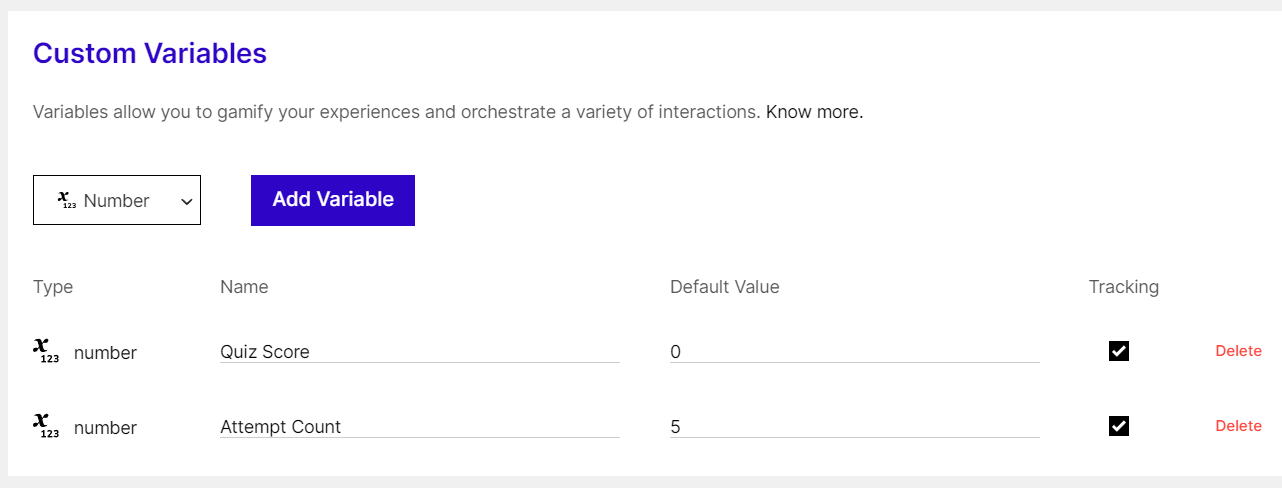
These are variables that you add manually to an experience. Go to [Settings > Variables](/metaverse/build/editor/project-settings/variables-in-settings.md), select the type of value you want to store and click "Add Variable". You can then rename the variable from the table below.
Checking the "*Tracking*" option allows you to later check the values stored for that variable, for every user, in Analytics Dashboard
Adding Custom Variables
### **Global Variables**
Global variables are available for use across all experiences in a workspace. The value of this variable is shared across experiences for any viewer.
Check the following page to learn how to define Global Variables:
{% content-ref url="/pages/4WXjxW1VM8UIm1RM0XE7" %}
[Defining Global Variables](/metaverse/build/portal/global-variables.md)
{% endcontent-ref %}
### **Autogenerated Variables**
These get added automatically. Check the list of autogenerated variables here:
{% content-ref url="/pages/L3MU0pK44lYKrssYhREZ" %}
[Autogenerated Variables](/metaverse/build/variables/autogenerated-variables.md)
{% endcontent-ref %}
---
# Agent Instructions
This documentation is published with GitBook. GitBook is the documentation platform designed so that both humans and AI agents can read, navigate, and reason over technical content effectively. Learn more at gitbook.com.
## Querying This Documentation
If you need additional information that is not directly available in this page, you can query the documentation by asking a question.
Perform an HTTP GET request on the following URL with the `ask` and `goal` query parameters:
```
GET https://docs.gmetri.com/metaverse/build/variables.md?ask=&goal=
```
`ask` is the immediate question: it should be specific, self-contained, and written in natural language.
`goal` is what the user is ultimately trying to achieve, the reason they need the answer. Sharing it helps GitBook give you a better, more relevant answer. A goal is most helpful when it describes the outcome the user wants rather than restating the question. For example, with `ask=how do I create an API token`, a goal like `automate deployments from our CI pipeline` lets GitBook tailor the answer to that use case.
The response will contain a direct answer to the question and relevant excerpts and sources from the documentation.
Use this mechanism when the answer is not explicitly present in the current page, you need clarification or additional context, or you want to retrieve related documentation sections.