> For the complete documentation index, see [llms.txt](https://docs.gmetri.com/llms.txt). Markdown versions of documentation pages are available by appending `.md` to page URLs; this page is available as [Markdown](https://docs.gmetri.com/metaverse/build/variables/autogenerated-variables.md).
# Autogenerated Variables
## Auto-generated Variables
Some variables are generated automatically when you create an experience or perform some action. Many of these variables have their values set automatically by the GMetri system. You can use these variables in your Experience logic using [Rules](/metaverse/build/rules.md)or [String Substitution](/metaverse/build/variables/string-substitution.md).
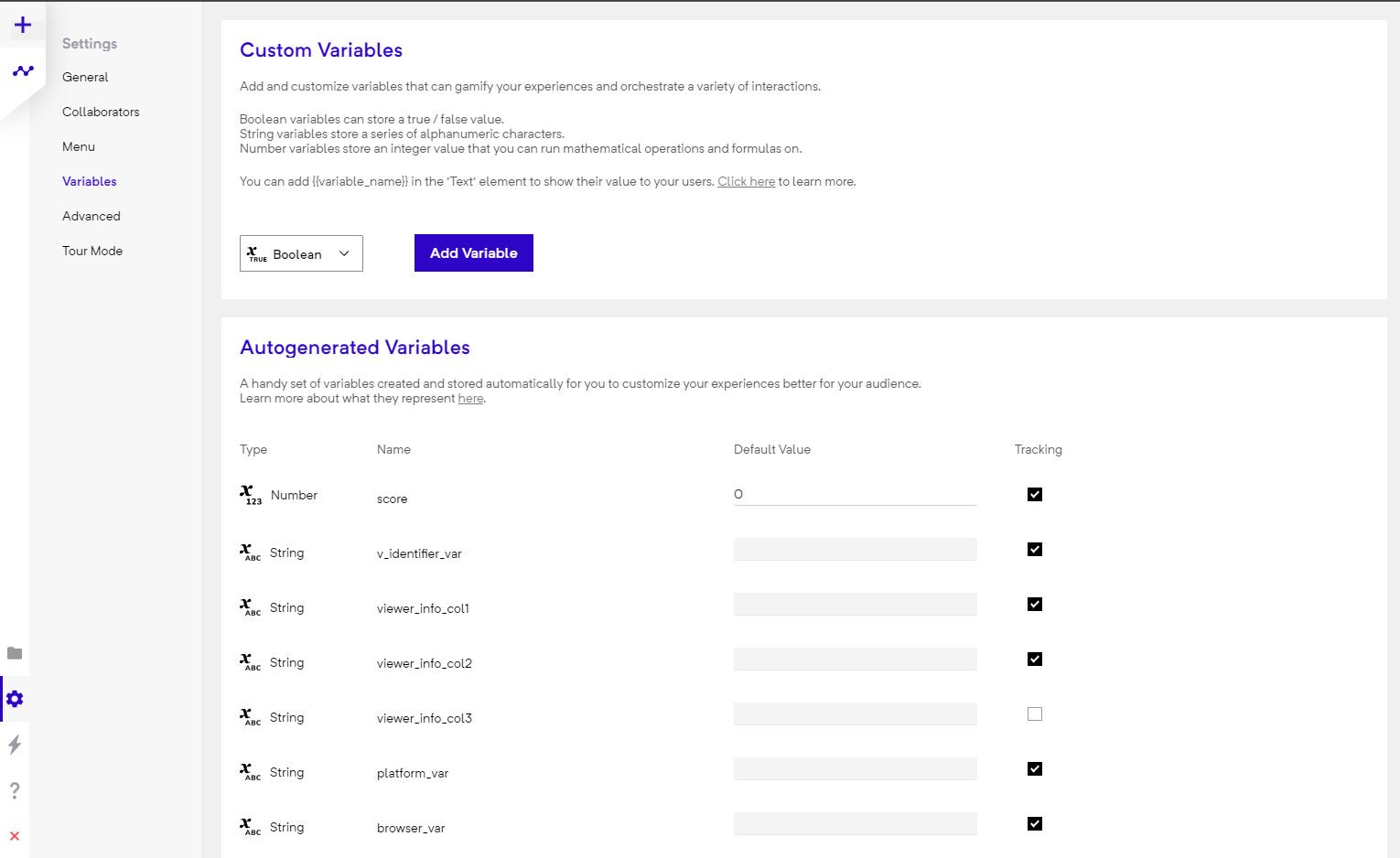
## Auto-generated Variables - **Predefined**
### v\_identifier\_var
`v_identifier_var` - A unique ID to identify each viewer who views the experience. This can be viewed in the analytics page. Can be email/name etc. - depends on the authentication mechanism used in the Deployment section.
### fullname\_var
`fullname_var` - A string variable that contains the full name of the user if we get it from the authentication mechanism.
### firstname\_var
`firstname_var` - A string variable that contains the first name of the user if we get it from the authentication mechanism.
### lastname\_var
`lastname_var` - A string variable that contains the first name of the user if we get it from the authentication mechanism.
### browser\_var
`browser_var` - This variable holds the information on the browser that a viewer uses. For a list of support browsers please check the platform compatibility matrix. Following values will be populated in the browser\_var when the viewer views an experience:
| Device | Browser | browser_var value |
|---|
| Laptop/PC | Safari | safari |
| Laptop/PC | Chrome | chrome |
| Laptop/PC | Edge | edge-chromium |
| iPhone | Chrome | crios |
| iPhone | Safari | ios |
| Android | Chrome | chrome |
| Oculus | Oculus browser | samsung |
### device\_var
`device_var` - Holds information about the viewer device type. Possible values: `d`,`m`,`h`.
* `d` -> Desktop
* `m` -> Mobile
* `h` -> Headset
### vrmode\_var
`vrmode_var` - Contains `TRUE` if the user enters VR Mode. Otherwise `FALSE`. Changes real-time to reflect the current state.
### scorm\_progress
Share the progress with a LMS.
### scorm\_suspend\_data
Share arbitrary data with a LMS. Persists across sessions.
### scorm\_score
Used to share score with a LMS
### player\_count\_var
Stores the total number of live viewers in the current room instance
### player\_count\_all\_var
Stores the total number of live viewers in all rooms
## Auto-generated Variables - Generated at Runtime
### score
`score` - This is a special number variable that's used to generate the leaderboard in the analytics section. Use this to store any overall score you may have in the experience.
### lang
`lang` - The `lang` variable can be used by enabling the `Show Language Screen` option in the settings section. To add languages, go to the `Languages` tab inside Splash Screen. This variable will hold the value of the language selected by the viewer.
Other actions like enabling [Lead Generation](/metaverse/build/editor/project-settings/lead-generation.md) form fields and adding Media Upload elements can also add auto-generated variables.
## Example Experience
Here's an experience you can use to check the value of autogenerated variables in different settings:
---
# Agent Instructions
This documentation is published with GitBook. GitBook is the documentation platform designed so that both humans and AI agents can read, navigate, and reason over technical content effectively. Learn more at gitbook.com.
## Querying This Documentation
If you need additional information that is not directly available in this page, you can query the documentation by asking a question.
Perform an HTTP GET request on the following URL with the `ask` and `goal` query parameters:
```
GET https://docs.gmetri.com/metaverse/build/variables/autogenerated-variables.md?ask=&goal=
```
`ask` is the immediate question: it should be specific, self-contained, and written in natural language.
`goal` is what the user is ultimately trying to achieve, the reason they need the answer. Sharing it helps GitBook give you a better, more relevant answer. A goal is most helpful when it describes the outcome the user wants rather than restating the question. For example, with `ask=how do I create an API token`, a goal like `automate deployments from our CI pipeline` lets GitBook tailor the answer to that use case.
The response will contain a direct answer to the question and relevant excerpts and sources from the documentation.
Use this mechanism when the answer is not explicitly present in the current page, you need clarification or additional context, or you want to retrieve related documentation sections.